

Uncensored
Unfiltered takes -Yes, there were women in the Frankfurt School: Feminists, militants and researchers
New research brings to light contributions from forgotten female figures

The Hidden Women of the Frankfurt School
Everyone knows the names Horkheimer, Adorno, and Marcuse. But look closely at the famous photograph from the Marxist Work Week — the gathering that laid the groundwork for the Frankfurt School — and you’ll find seven women who history almost forgot.
They weren’t wives hovering in the background. They were an actress, a philosopher, a journalist, a librarian, an educator, an economist, and a feminist thinker. Hede Massing, Hedda Korsch, Gertrud Alexander, Rose Wittfogel, Käthe Weil, Christiane Sorge, and Margarete Lissauer were all educated, politically active, and deeply embedded in the Institute for Social Research (ISR) — the organization that would become the legendary Frankfurt School.
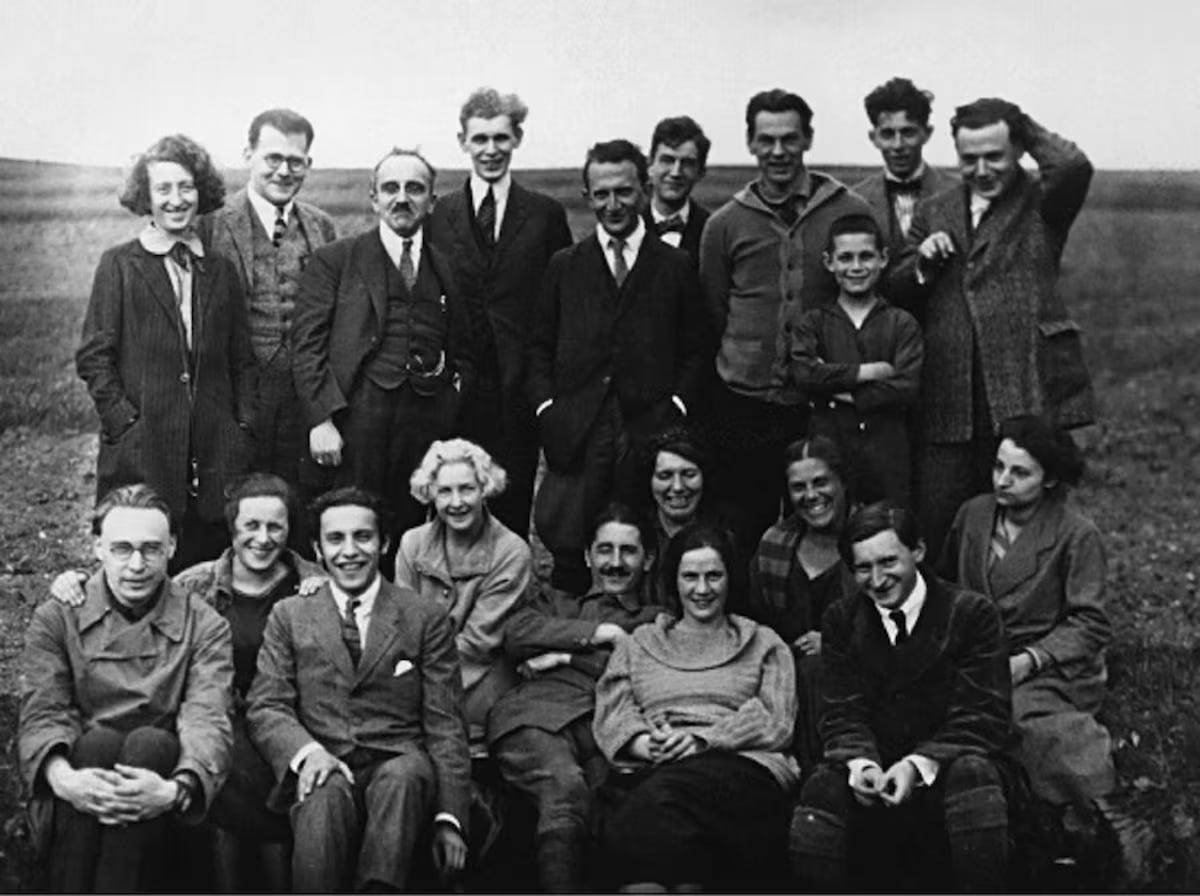
For a century, their contributions were either uncredited or buried beneath footnotes.
A Book That Changes the Story
A new Spanish-language volume, En las sombras de la tradición (published by Eterna Cadencia), is working to correct the record. Released to mark the 100th anniversary of the ISR’s founding, it brings together research that recovers the stories of these overlooked figures — drawing not just on official archives, but on letters, interviews, and oral histories.
Sarah Speck, deputy director of the ISR, puts it plainly: “We all know that the story of the Frankfurt School is a male story. With this book, we are really changing that perspective.”
Argentine philosopher Verónica Gago, who wrote the prologue, identifies the core problem: these women were consistently labeled as wives, assistants, librarians, or secretaries. “The first step,” she says, “was to recognize their specific contributions — in theoretical practice, and through a methodology of collaborative work.” She calls it “the kitchen of the research”: everything essential that had to happen before the famous thinkers could write, think, and publish.
One Woman’s Story: Käthe Leichter
Perhaps no figure better illustrates this erasure than Käthe Leichter (1895–1942), a labor activist, socialist, and Viennese intellectual from a bourgeois Jewish family.
Leichter studied political science and threw herself into labor and women’s movements at the end of World War I. Her connection to the ISR went back to its very founding — in her memoir, she recalls recommending its first director, Carl Grünberg, for the position. She later helped develop Studies on Authority and Family, one of the ISR’s landmark collaborative projects, designing questionnaires and drafting early results. When Horkheimer published the final text, her name appeared only in passing, buried in the body of the chapters.
She was doing the work. Someone else got the byline.
When Nazism made continued collaboration impossible, Leichter stayed in Austria rather than fleeing into exile. She joined the resistance, was eventually captured, and was murdered at the Bernberg Psychiatric Hospital in 1941 or 1942. Even in Ravensbrück concentration camp, survivors recalled, she never stopped her research and political work.
Multitaskers Before the Word Existed
Gago describes these women as combining “empirical work, theoretical reflection, political agitation, and militancy” — all at once, often without recognition. While the School’s male figureheads were pictured as geniuses with cigars and whisky debating grand philosophical ideas, the women around them were bridging the gap between academia and real-world movements.
Three researchers connected to the ISR — Mirra Komarovsky, Helge Pross, and Regina Becker-Schmidt — went on to become pioneers in gender theory after leaving the organization. Their intellectual roots in the ISR have largely gone unacknowledged.
“There was a disconnect in the 1960s between the best-known figures of the ISR and social movements,” Gago notes. It’s now becoming clear that it was many of the women, not the celebrated men, who maintained those connections.
Why It Matters Now
This kind of recovery work is happening across disciplines. The Bauhaus had Anni Albers and Marianne Brandt. Abstract painting was associated with Hilma af Klint. Surrealism had Leonora Carrington and Remedios Varo. In each case, women who shaped entire movements were systematically sidelined while their male contemporaries became the official story.
Philosophy professor Lorena Acosta captures it well: “If there is no periphery, the center does not exist. Without all the work in the shadows, there would have been no tradition as such.”
The Frankfurt School built one of the 20th century’s most influential critiques of society, culture, and power — a critique of oppression and hierarchy in all its forms. The irony that it reproduced those same hierarchies internally is uncomfortable, but important to face.
The women were there. It’s past time we said their names.