

When England’s Most Daring Privateer Set Out to Circle the World

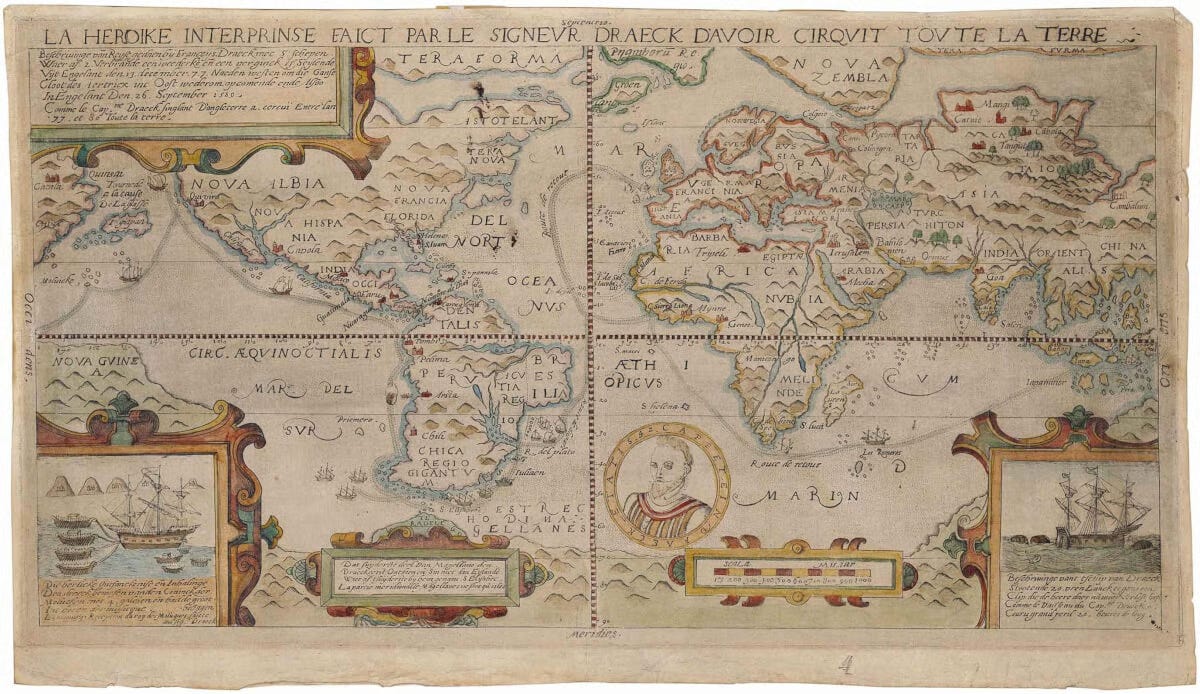
On December 13, 1577, five ships slipped out of Plymouth Harbor under the command of a man who would become one of history’s most legendary navigators. Francis Drake, a seasoned privateer with a reputation for audacity and seamanship, embarked on what would become only the second successful circumnavigation of the globe, a journey that would transform him from a controversial sea captain into a national hero.
The Fleet That Dared to Dream
Drake’s expedition consisted of five vessels, led by his flagship, the Pelican, a galleon of approximately 100 tons. The fleet also included the Elizabeth, Marigold, Swan, and Christopher. Together, they carried about 164 men and enough provisions for what Drake publicly claimed would be a trading voyage to the Nile. But the true mission, known only to Drake and Queen Elizabeth I, was far more ambitious and dangerous.
The Pelican would later be renamed the Golden Hind during the voyage, possibly in honor of Sir Christopher Hatton, one of Drake’s financial backers, whose crest featured a golden hind (a female deer). This ship would become one of the most famous vessels in maritime history.
A Mission Shrouded in Secrecy
Drake’s official orders were deliberately vague, but his real objectives were clear to those in the know: raid Spanish colonies and ships along the Pacific coast of South America, explore potential trading opportunities, and perhaps discover the fabled Northwest Passage. England and Spain were engaged in an undeclared war, with English privateers serving as the queen’s unofficial navy, striking at Spanish treasure while maintaining plausible deniability.
The Spanish had grown complacent in the Pacific, which they considered their private lake. Their treasure ships sailed virtually undefended, laden with silver from the mines of Peru and gold from the conquered Incan empire. Drake saw an opportunity that was too tempting to resist.
The Journey Begins
As the five ships sailed from Plymouth on that winter day in 1577, few aboard could have imagined the extraordinary odyssey that lay ahead. They would face storms that would scatter the fleet, mutiny among the officers, encounters with indigenous peoples, and the constant threat of Spanish retaliation. Of the five ships that departed, only the Golden Hind would complete the circumnavigation.
The voyage would take Drake through the Strait of Magellan, up the Pacific coast of South America in a devastating raid on Spanish settlements and shipping, possibly as far north as present-day Oregon or even British Columbia, across the Pacific to the Spice Islands, around the Cape of Good Hope, and finally back to England in September 1580.
A Legacy Cast in Gold
When Drake returned nearly three years later, his ship was laden with Spanish treasure worth an astronomical sum, perhaps equivalent to half of England’s annual revenue. More importantly, he had proven that English ships could challenge Spanish dominance anywhere in the world. Queen Elizabeth herself came aboard the Golden Hind and knighted Drake on its deck, transforming a privateer of questionable reputation into Sir Francis Drake, a symbol of English maritime prowess.
The departure on December 13, 1577, marked the beginning of an adventure that would reshape the balance of power on the world’s oceans and help establish England as a naval superpower. It was a journey born of ambition, greed, patriotism, and sheer audacity, qualities that Drake possessed in abundance.
As the Pelican caught the wind and sailed toward the horizon that December day, no one watching from shore could have known they were witnessing the start of one of history’s greatest maritime adventures. But Drake knew. And that made all the difference.