

The Planet That Doesn't Forget

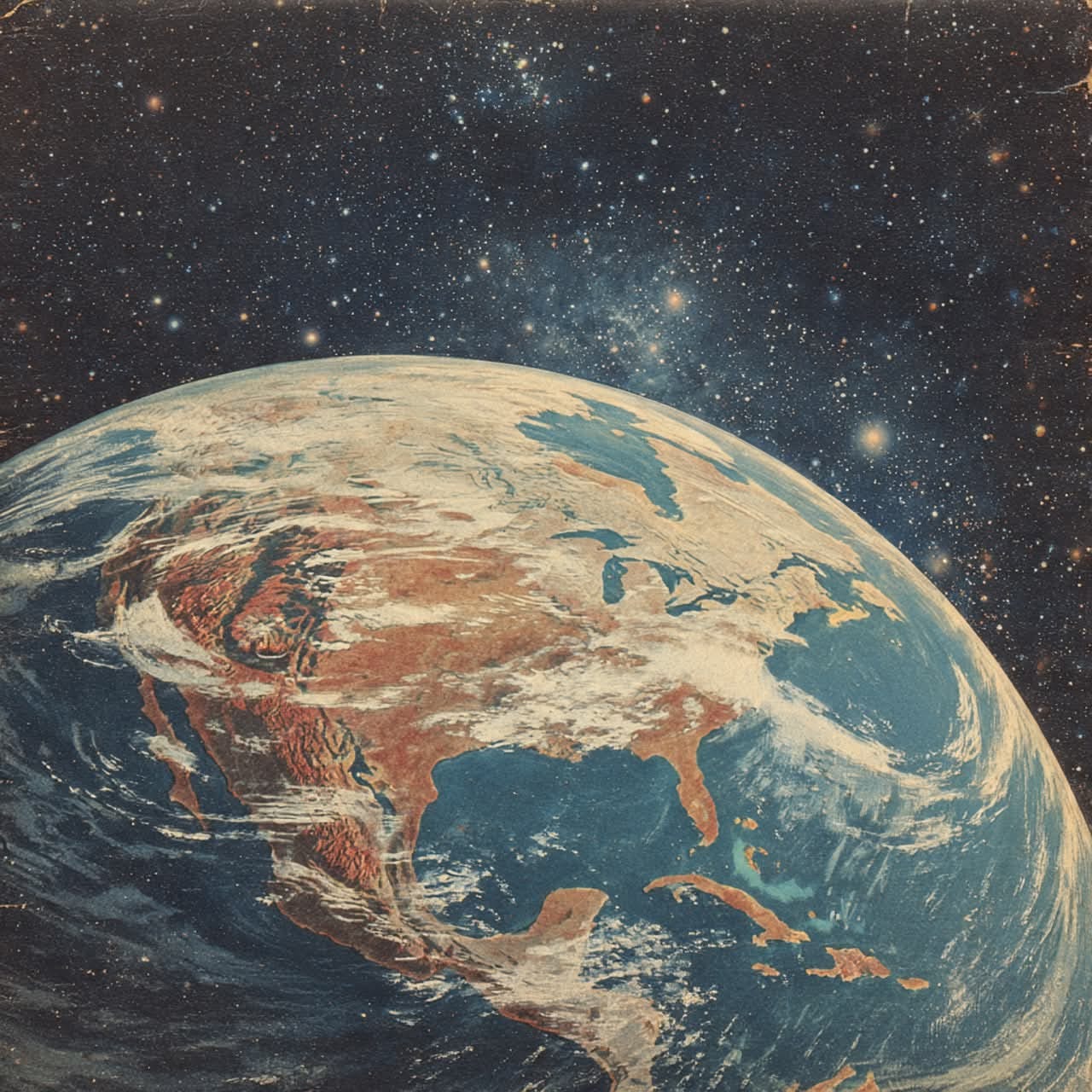
Watch a figure skater mid-spin. Arms out, then pulled sharply to the chest — and the body suddenly whips around faster, as if some outside force had given it a push. Nothing did. The law behind that sudden acceleration is the same one that has kept Earth spinning at almost the same rate for billions of years: conservation of angular momentum.
It's one of those physical laws that asks for nothing in return. It needs no force to sustain it, no fuel, no maintenance. If no external torque acts on a system, its total angular momentum stays constant — full stop. And Earth, spinning in the near-perfect vacuum of space, is about as close as nature gets to that idealized system.
What angular momentum actually is
Angular momentum is, in essence, an object's "quantity of rotation" — it depends on how fast something spins, how much mass it has, and how that mass is distributed relative to the axis of rotation. The simplified formula for a rigid body is L = Iω, where I is the moment of inertia (which depends on mass distribution), and ω is the angular velocity.
What matters is the relationship between those two terms. If I decreases — mass moves closer to the axis — then ω must increase to keep the product constant. That's exactly what the skater does by pulling in their arms: I shrinks, so ω, the spin rate, shoots up, with no extra push from outside. Physics doesn't negotiate on this.
Earth is a planetary-scale, far lazier and more stable version of the same phenomenon.
Why Earth doesn't need an engine
It's tempting to assume, intuitively, that something as massive as our planet needs to be "powered" to keep spinning — the way a bicycle wheel needs pedaling. But space has no friction. There's no air to slow Earth's rotation the way it slows a wheel rolling on asphalt. Once the planet formed with a certain amount of angular momentum inherited from the collapsing protoplanetary disk that gave birth to it, that angular momentum stayed, broadly speaking, locked into the system.
Motion doesn't need a continuous force to persist — it needs one to change. And in Earth's case, external forces capable of meaningfully altering its rotation are rare and, as a rule, extremely slow.
The exception that proves the rule: the Moon
Here's a nuance most people miss, and it's what makes the story richer rather than simpler. Earth doesn't actually spin at a perfectly constant rate — it spins at a rate that changes so slowly that, on a human timescale, it looks unchanging.
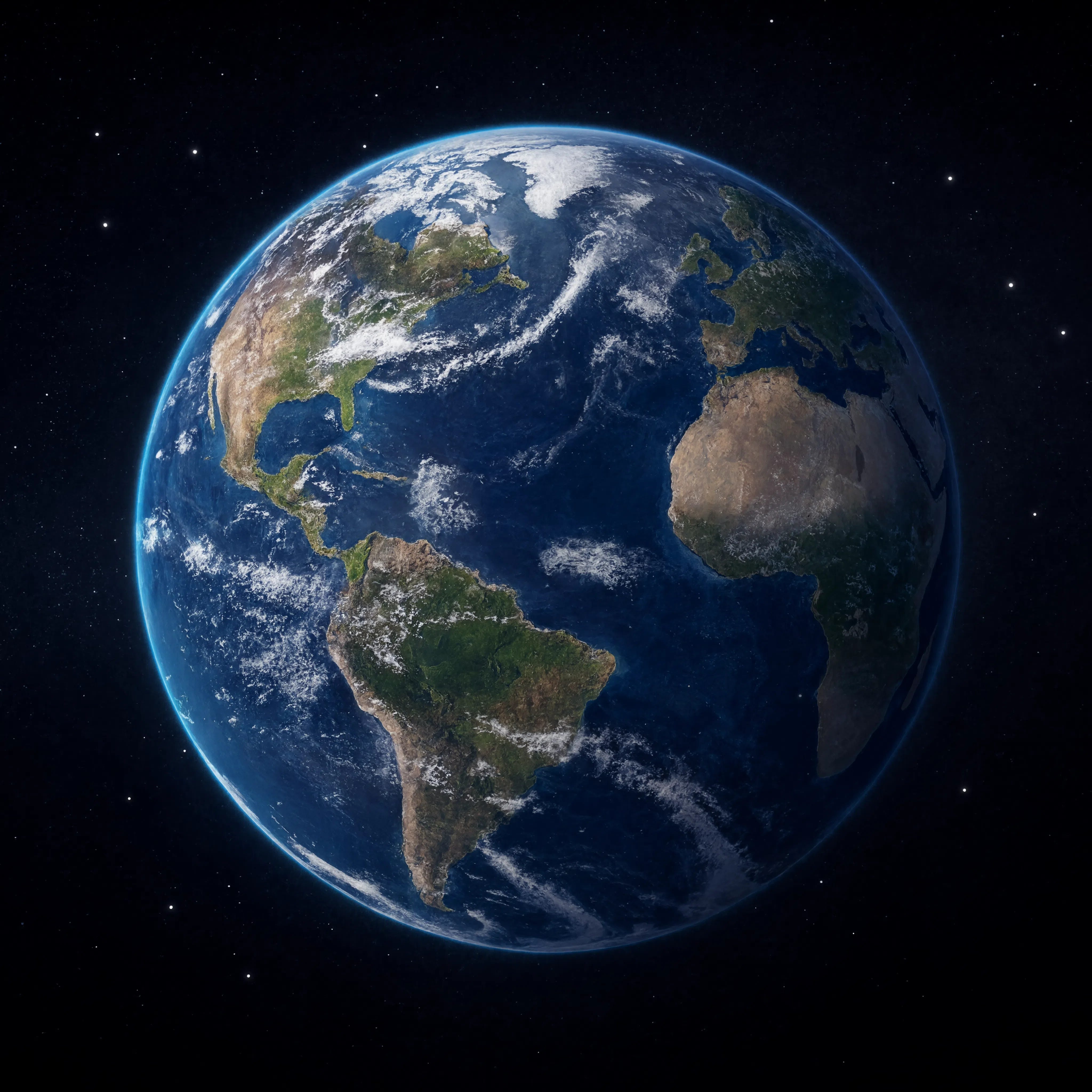
The culprit is the Moon. Its gravitational pull raises tidal bulges on Earth, and the friction between those moving masses of water (and, to a lesser degree, the solid crust) and Earth's rotation acts as an extraordinarily gentle brake. That tidal friction transfers angular momentum from Earth's spin to the Moon's orbit — which is why the Moon drifts away from us by about 3.8 centimeters a year, and our days lengthen by roughly 1.7 milliseconds per century.
Hundreds of millions of years ago, a day on Earth lasted only about 21-22 hours — evidence preserved, remarkably, in the daily growth rings of fossilized corals and in the rhythmic layering of tidal sediments, which function as a kind of geological calendar.
So the more accurate version of the story isn't "Earth spins at a constant rate," but something more precise and, arguably, more beautiful: the angular momentum of the Earth-Moon system, taken together, is almost perfectly conserved, but it's continuously redistributed between the two bodies. What Earth loses in spin, the Moon gains in orbital distance.
Earthquakes, melting ice, and shorter days
There are also much faster events that shift — infinitesimally, but measurably — Earth's rotation rate, through the same mechanism as the skater's spin.
Large earthquakes redistribute mass inside the planet. The 2011 Tōhoku earthquake in Japan was powerful enough to shift mass slightly toward the planet's center, reducing Earth's moment of inertia just enough to shorten the day by about 1.8 microseconds. Imperceptible to anyone, but perfectly measurable by atomic clocks.
Melting ice sheets work the opposite way, through a different mechanism: water flowing from the poles toward the equator (as global sea levels rise) moves mass farther from the rotation axis, which should, in theory, slightly slow the spin — an effect some researchers cite as a partial explanation for recent anomalies in day length.
The clocks that caught the planet lying
Modern technology has become precise enough to catch these tiny variations in real time. Atomic clocks, accurate to within a second over hundreds of millions of years, have shown that Earth's rotation not only slows over the long term but also fluctuates irregularly over shorter periods, tied to currents in the planet's liquid core, the atmosphere, and the oceans.
In fact, in recent years an unexpected problem has emerged: in some stretches, Earth has been spinning slightly faster than its historical average — enough that international timekeepers are, for the first time, weighing the possibility of a "negative leap second," subtracting rather than adding a second to keep civil time synced with the planet's actual rotation.
A law with no exceptions, a planet full of nuance
What's left, at the end of the story, is a striking contrast: the law of conservation of angular momentum is absolute, with no loopholes, no conditions — if there's no net external torque, a system's total angular momentum doesn't change. But the real "system" is never a single, rigid, isolated ball. It's Earth, the Moon, the oceans, the polar ice, the molten core, the atmosphere — all constantly trading small fragments of the same conserved total among themselves.
The result is a planet whose rotation looks, from the vantage point of a human lifetime, almost perfectly constant — and which is, in fact, a dynamic system in continuous equilibrium, where every earthquake, every bit of melting ice, every millimeter the Moon drifts away logs a tiny adjustment in a cosmic ledger kept with a precision no bank on Earth could match.
The skater pulls in their arms and spins faster. Earth loses, millimeter by millimeter, rotational energy to a Moon that keeps drifting away. Both are obeying the same law — one of the very few in the universe that never makes an exception.
Think of this as buying me a coffee at a layover — except the coffee turns into more reporting on how the news actually shapes your next trip. Buy me a coffee www.paypal.me/adrianmcvey