

The Grid Against the Sand
For fifty years, China has pushed back the desert one straw square at a time. The land is healing — but scientists say the grid can never be allowed to rest.

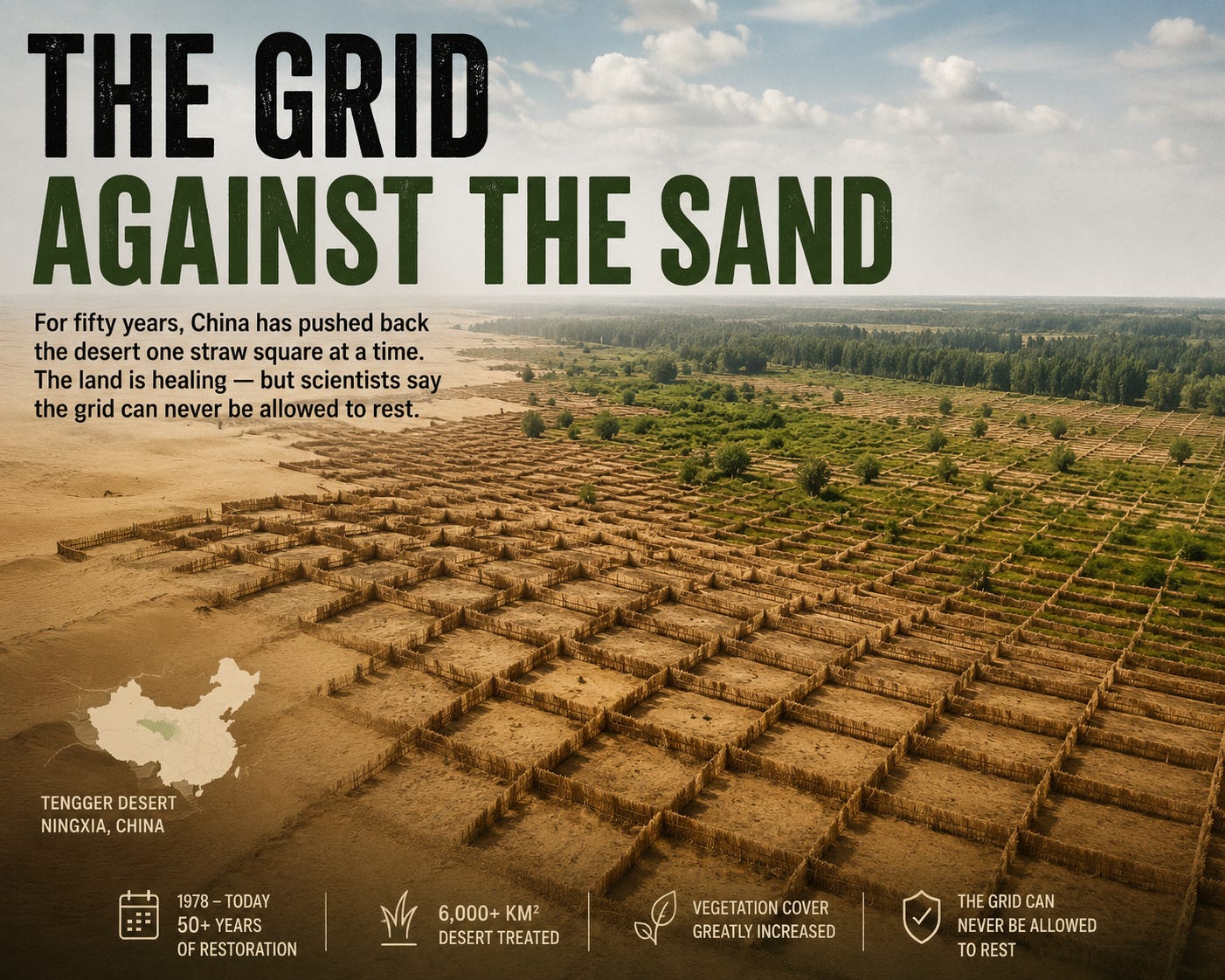
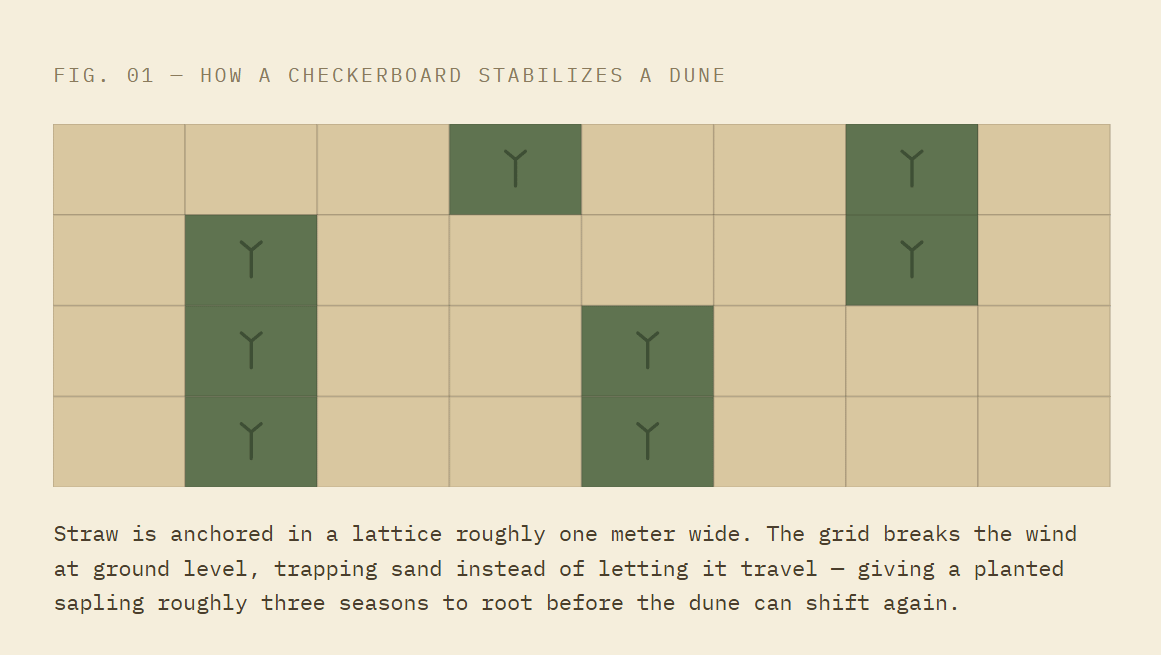
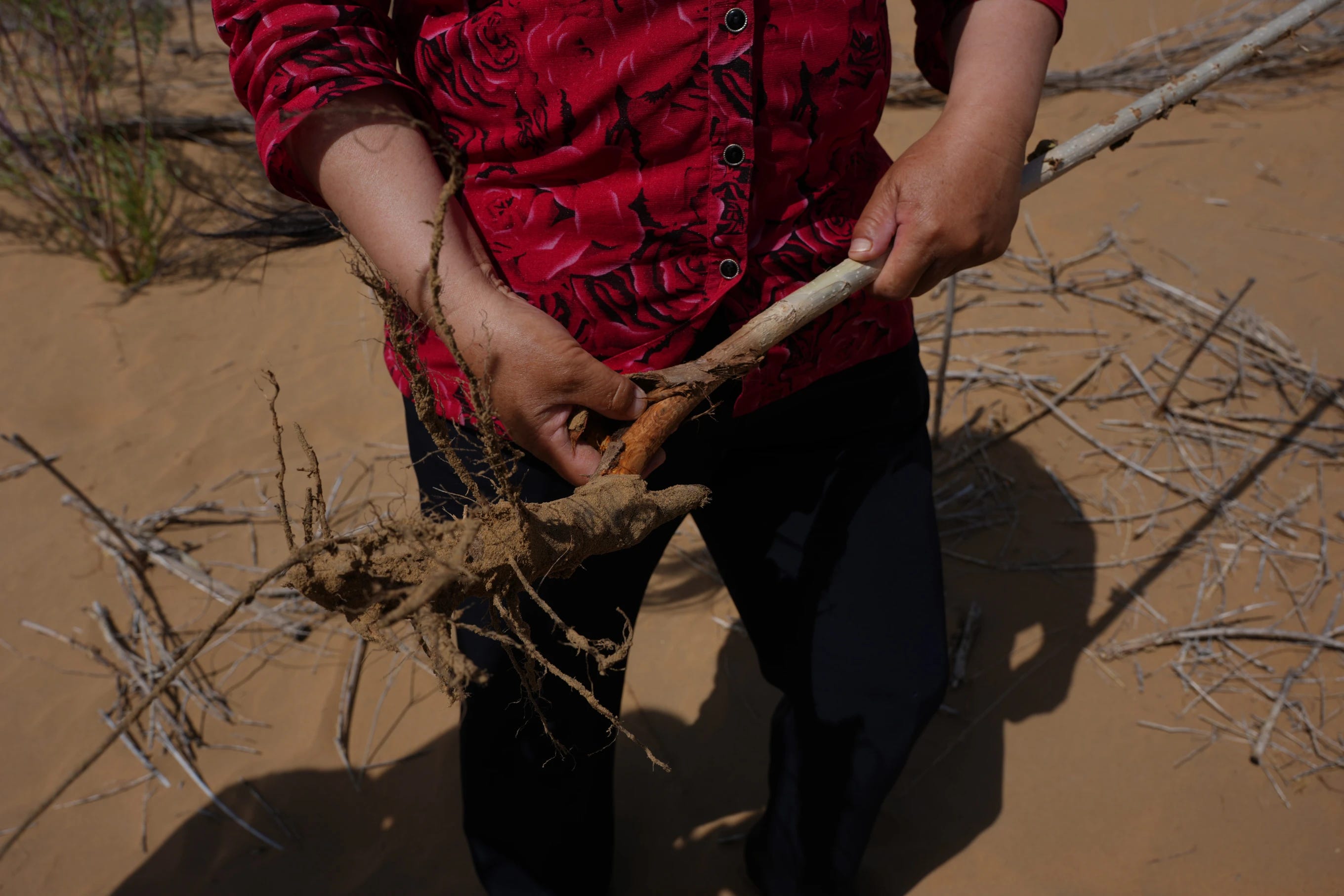
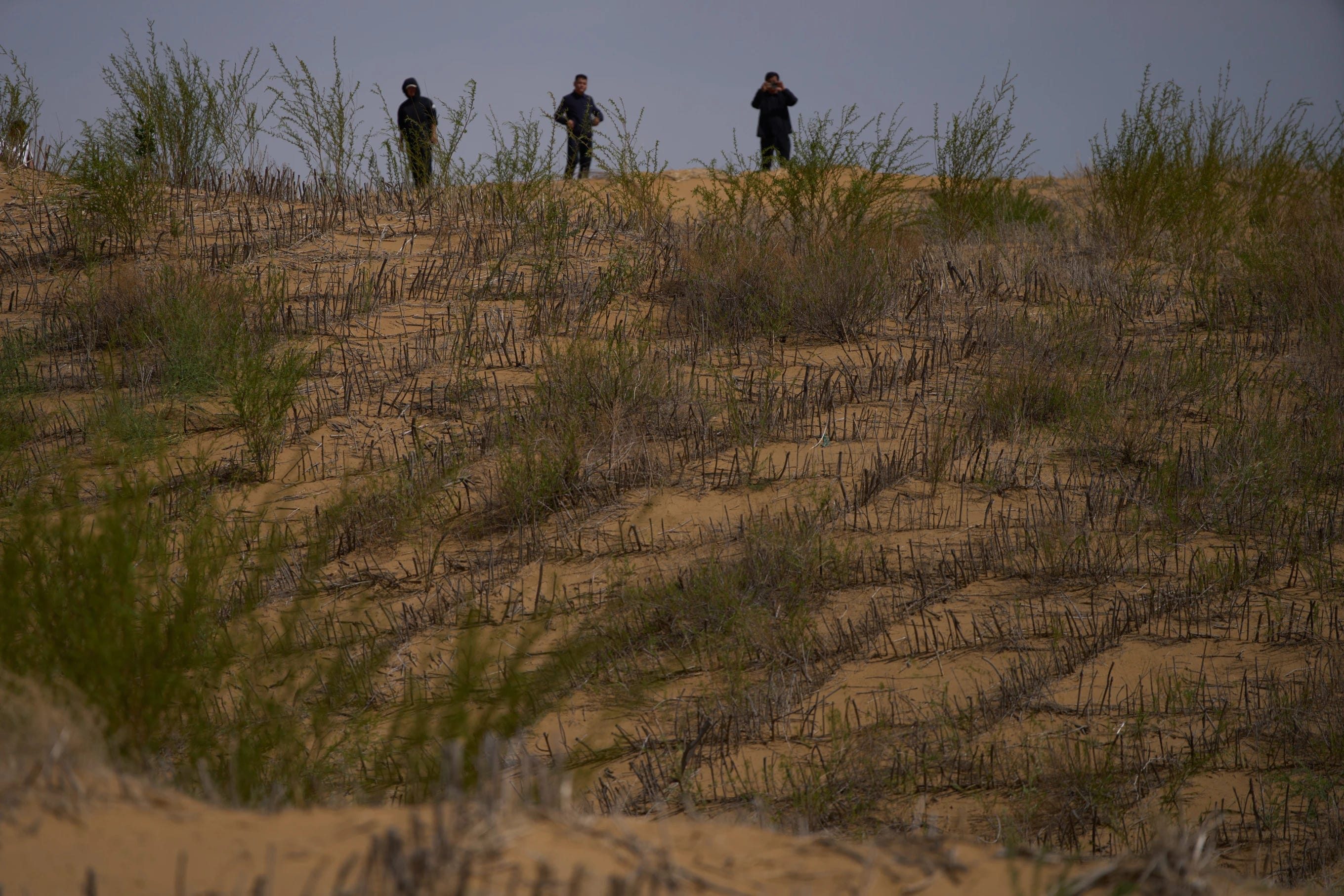
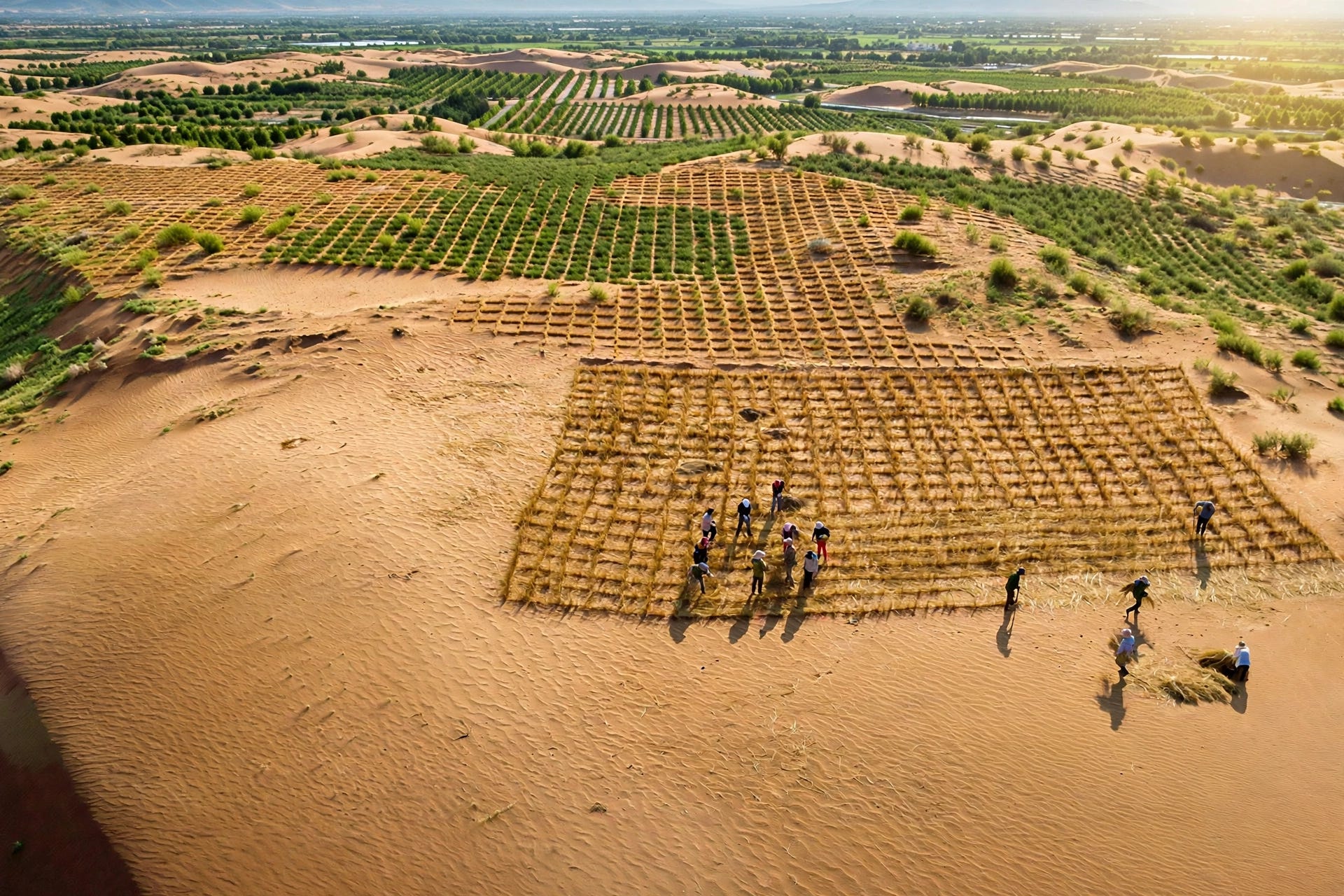
Inserting forearm-length sticks into shifting sand, first in a row, then in an intersecting line, until a grid emerges — this is the gesture that has been repeated by millions of hands across northern China for half a century. At the center of each small square, a worker plants a sapling. Water follows through a buried irrigation line. The dune, for a while, stops moving.
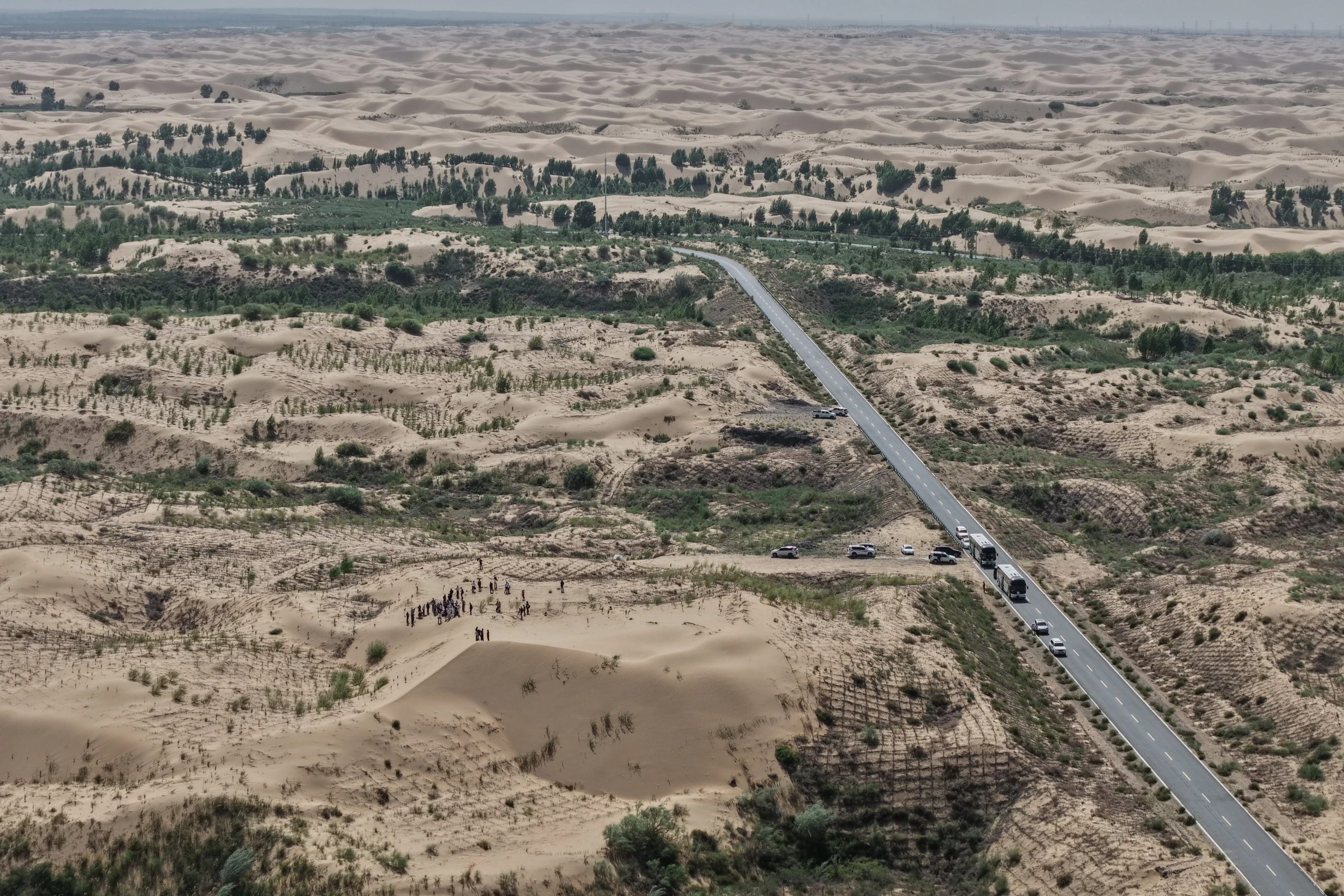
The technique is called a straw checkerboard. It is unglamorous, manual, and endlessly repetitive — and it has become the visual signature of one of the largest ecological engineering efforts ever attempted: the Three-North Shelterbelt Program, known more widely as China’s Green Great Wall.
The Method: Fifty Years, One Repeated Gesture
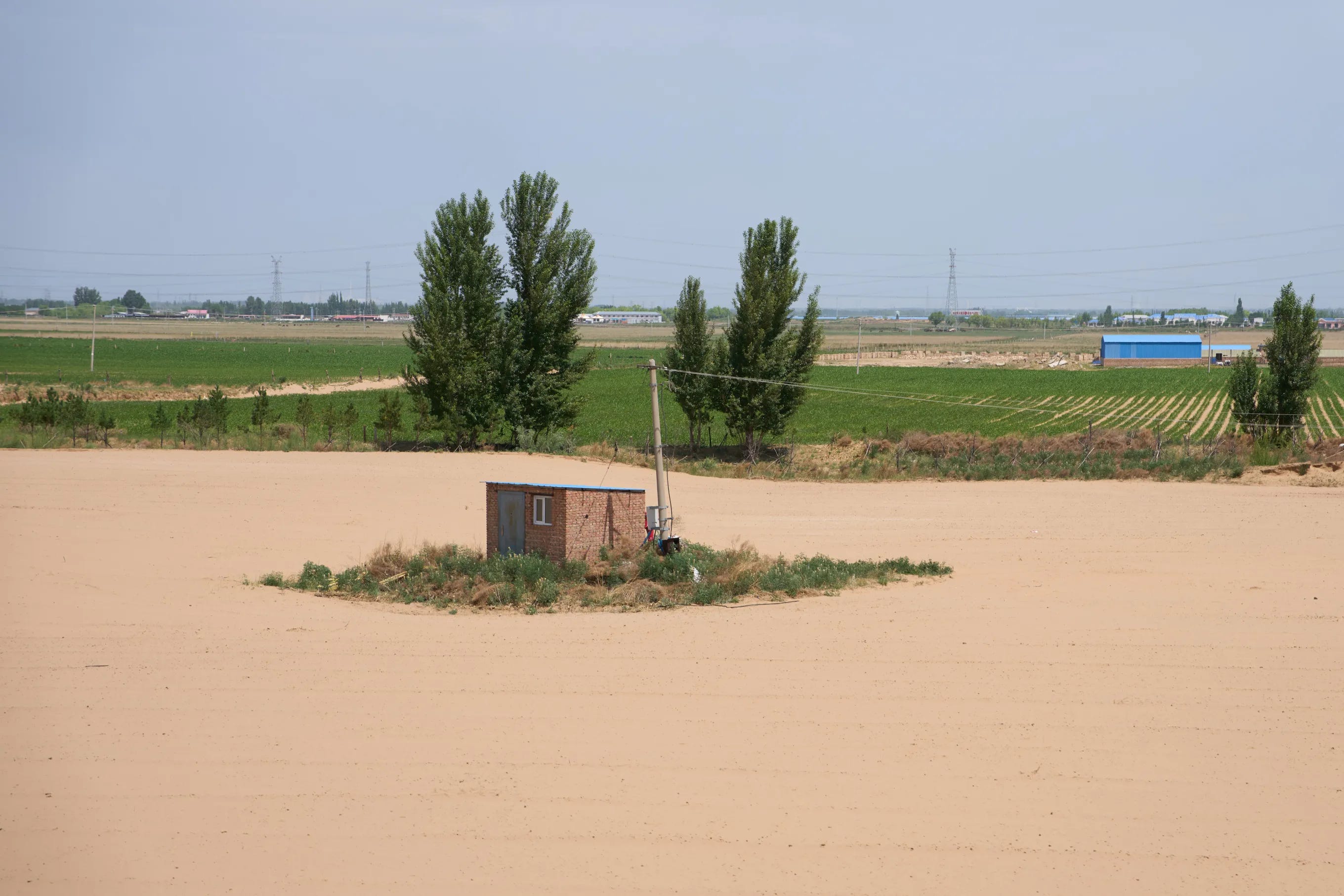
Desertification is not the desert itself — it is land that used to hold vegetation and no longer can. Across northern China, decades of drought, overgrazing, and farming stripped topsoil and vegetation from marginal land, leaving it exposed to wind erosion. Once the plant cover goes, sand begins to travel, burying irrigation canals, roads, and villages in its path.
The program launched in 1978 to reverse that trajectory across a belt of land covering nearly half the country. It combined the checkerboard technique with large-scale tree planting, shelterbelt corridors, and — critically — a sustained, multi-generational commitment from the state. Barron Joseph Orr, chief scientist for the U.N. Convention to Combat Desertification, frames the program’s significance less around its scale than around its endurance: reversing desertification becomes possible only when the effort is folded into a long-term development strategy, rather than treated as a single campaign with an end date.
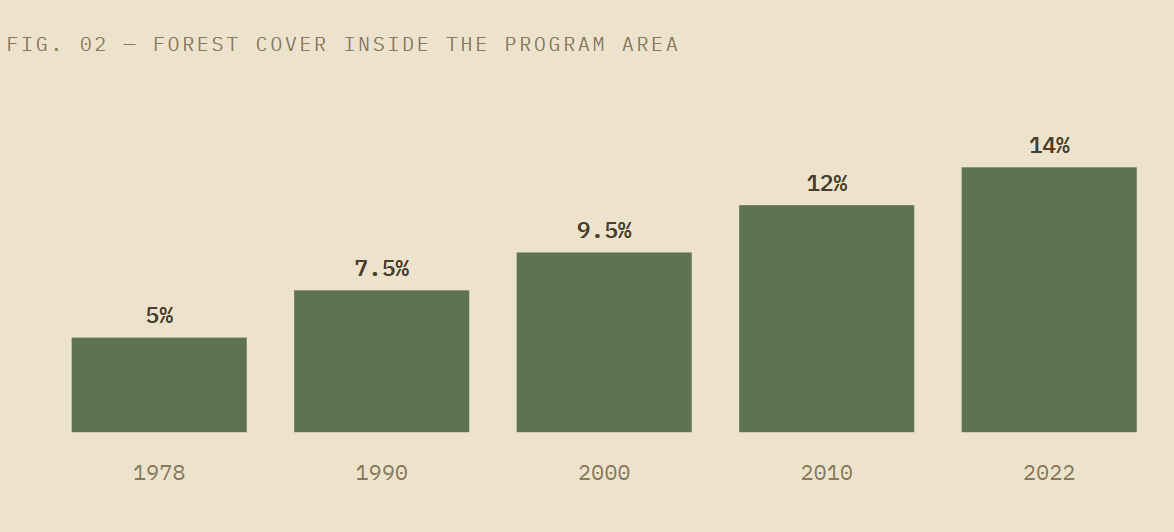
According to long-term monitoring by Zhu Jiaojun, a scientist at the Chinese Academy of Sciences’ Institute of Applied Ecology, forest cover across the program area rose from roughly 5% in 1978 to 14% by 2022. Overall, desertified land nationwide has shrunk by around 10% since 2000, with the most severely degraded land down by more than 40%. Zhu is careful to credit more than hard labor: rainfall has been kinder in some regions in recent years, and that has made vegetation easier to establish. “The achievement of desertification combat is due to people’s hard work and a bit of luck with the climate,” he said.
The Worker: The Woman Who Waited for Birds
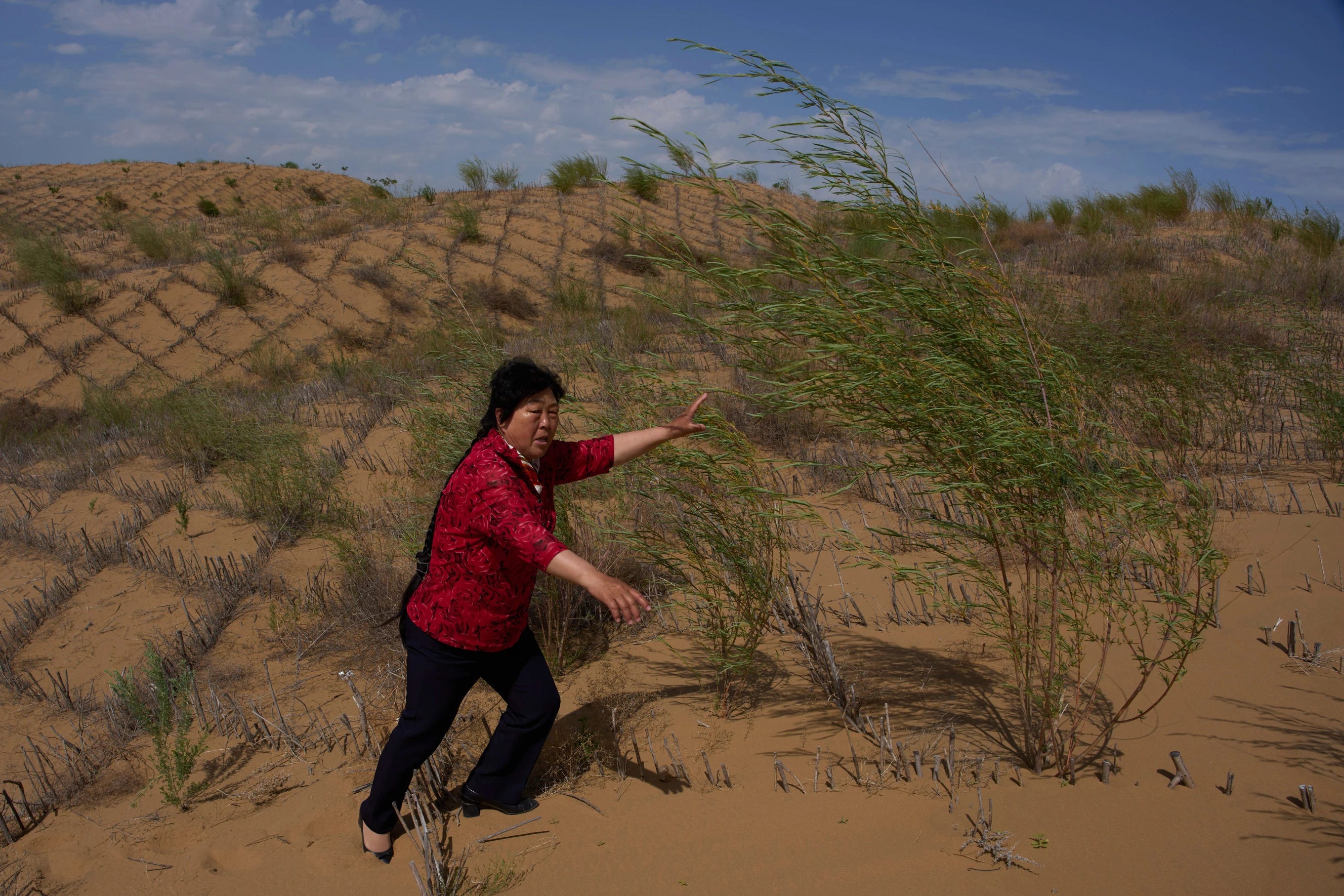
Statistics describe the program from above. Yin Yuzhen describes it from inside a single dune. Now 60, she began working the sand near her hometown in the Mu Us desert alongside her husband, in a stretch of land now part of the Kubuqi restoration zone. Her early memory of the work is not of soil science, but of solitude.
“Even the passing of a bird across the sky made me happy.”Yin Yuzhen, sand-control worker, Mu Us Desert
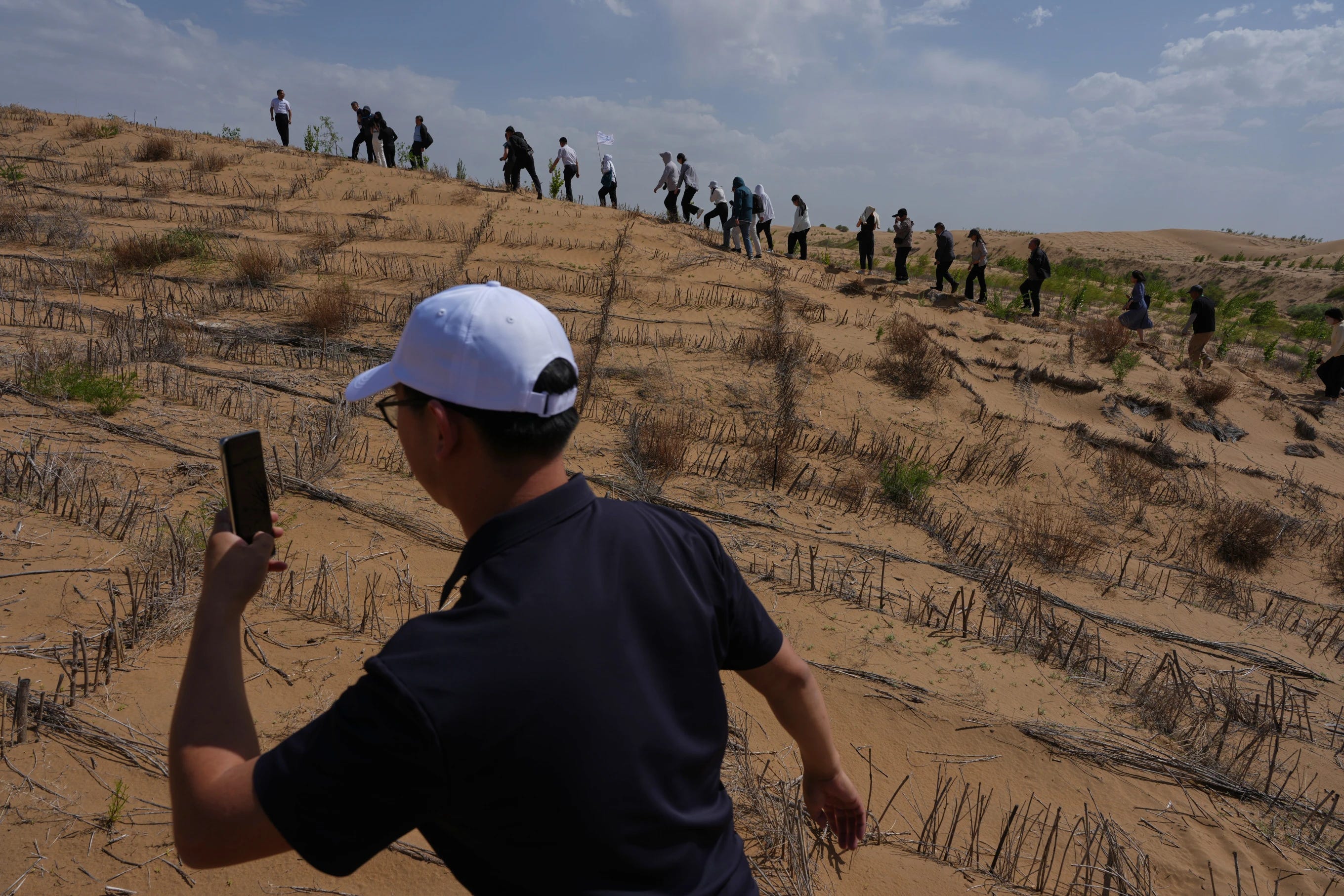
Four decades ago, she recalls, windblown sand was thick enough to blur the view a short distance ahead. Today, from the same ground, “we can see the sun. We can see the green in the distance. We can see the road.” She and her husband still work from dawn to noon most days — tending trees, replacing rotted straw, resetting checkerboards the wind has undone — joined now by their children and, occasionally, volunteers who travel out to help.
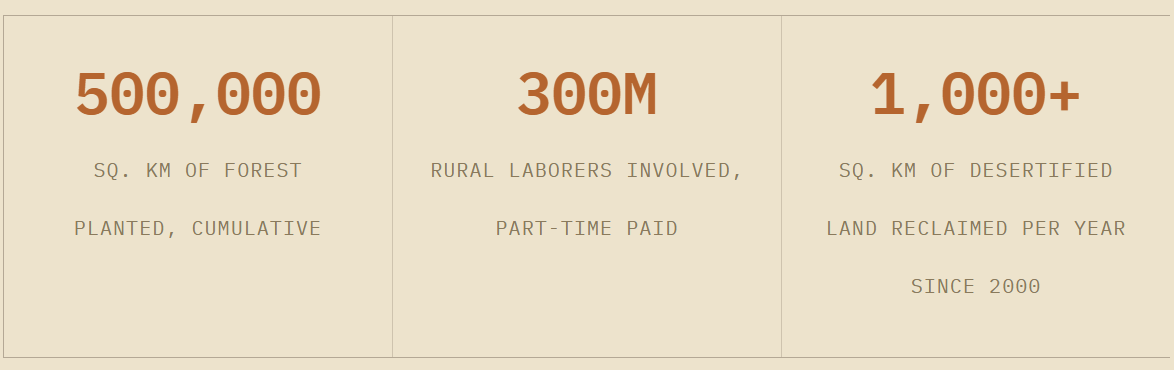
Zhu estimates that more than 300 million rural laborers have taken part in the program over its history, most working part-time for pay. It is, in that sense, less a single infrastructure project than a labor movement sustained across generations — grandparents, then parents, then children, returning to the same dunes with the same tools.
The Open Question: A Restoration That Cannot Rest
Every scientist who has studied the program offers the same caveat: the numbers are real, and the numbers are not permanent. Orr notes that restored dryland ecosystems can become increasingly self-sustaining over time, but they never fully leave human hands — they still require ongoing management and monitoring, and their fate still turns on water availability and soil health that can shift with climate.
Zhu poses the harder version of the same question: what happens to a restored landscape if the scale of human intervention — the labor, the investment, the constant re-anchoring of straw against wind — is ever reduced? “This is what we are very concerned with, and this is also the biggest challenge,” he said.
In Gansu province, the environmental group Green Camel Bell works on this problem from the ground up, helping farmers and herders understand desertification risk and plant trees on land they depend on for their income. Its founder, Zhao Zhong, argues that restoration only holds if it stops being framed as a trade-off — that “efforts to combat desertification and restore forests should be linked to local livelihoods, so communities do not see economic development and ecological protection as an either-or choice.” Orr’s research points the same way: restoration is far more durable when the people doing the work also benefit economically from its success.
Elsewhere: Not the Only Green Wall
China’s is the greatest and longest-running effort of its kind, but it is not alone. A comparable ambition is underway along the southern edge of the Sahara.
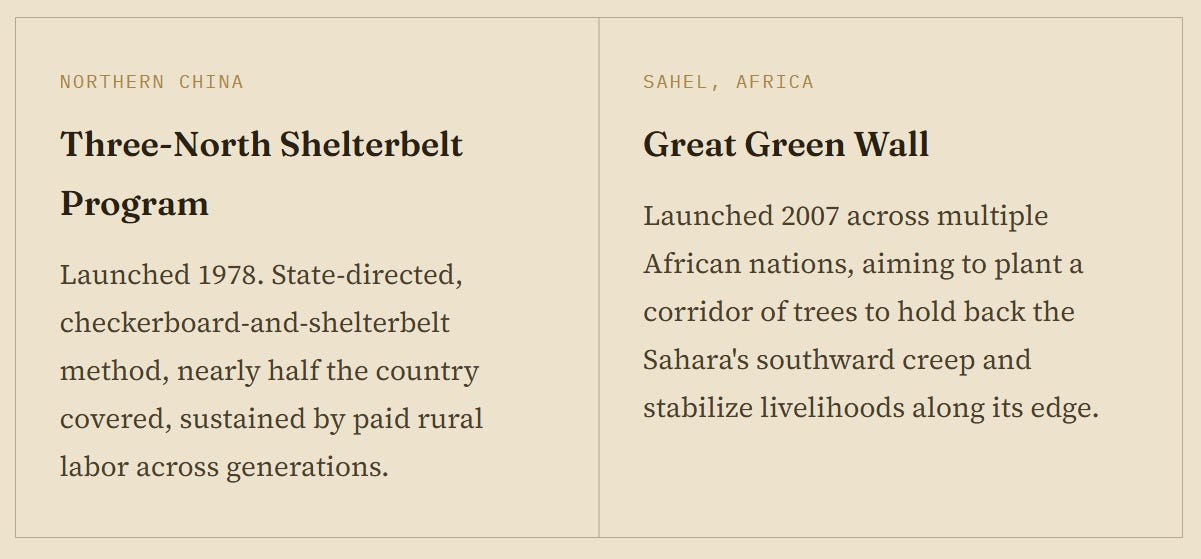
Both projects share a premise worth sitting with: that a desert’s edge is not a fixed line but a frontier that moves in whichever direction people stop paying attention to it.
“We need to teach young people to love this Earth. If we love it with all our hearts, nature will love us in return.”
Yin Yuzhen
Buy me a coffee www.paypal.me/adrianmcvey
True patrons of the green sand belt, the earth will always behold you in its arms even though rough winds comes in all directions, this love earth will win. This is so amazing