

Earth’s Forgotten Reactors: The Natural Nuclear Fission of Oklo
How a Uranium Mine in Gabon Revealed a 2-Billion-Year-Old Secret

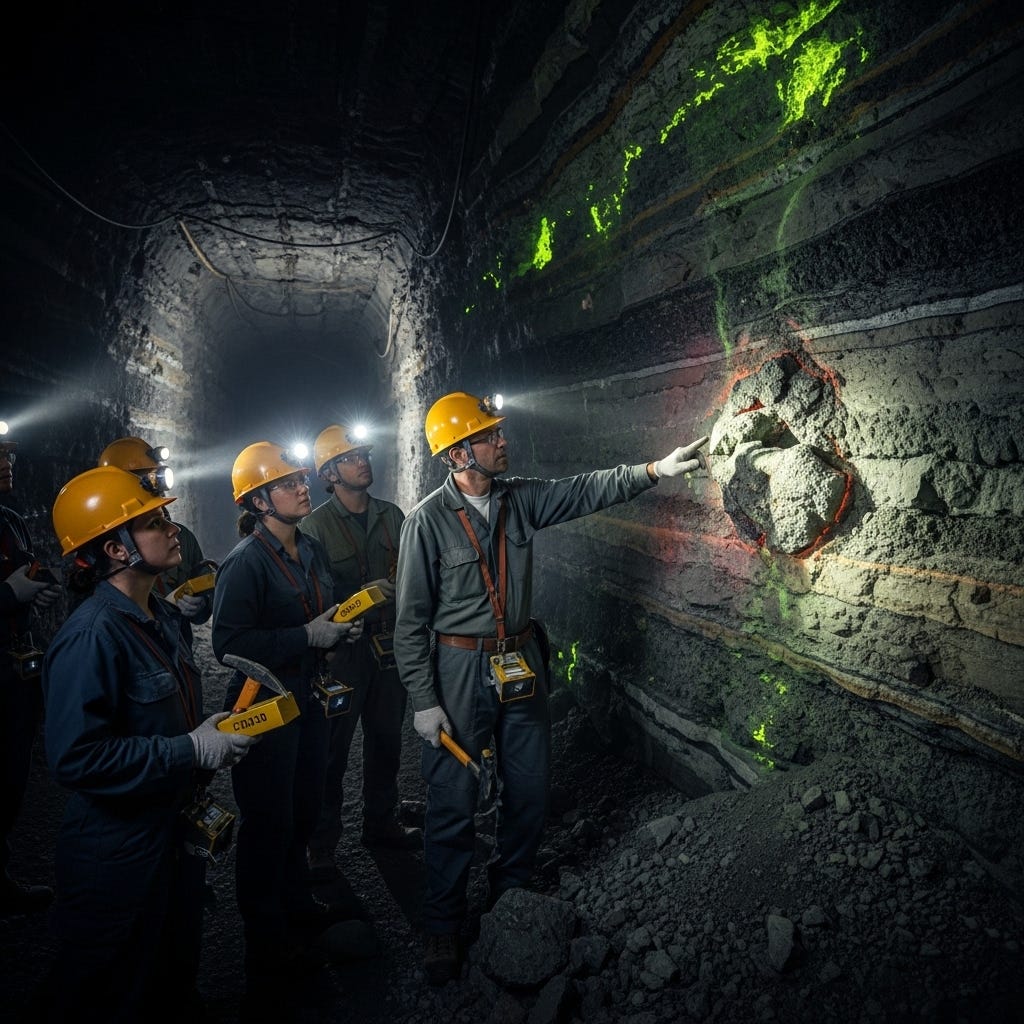
In 1972, a quality-control technician at a French nuclear fuel processing plant in Pierrelatte noticed something that should have been impossible. A shipment of uranium ore from the Oklo mine in Gabon, West Africa, was missing uranium-235 — the fissile isotope that powers nuclear reactors and weapons.
Every sample of natural uranium on Earth, whether mined in Canada, Australia, or Africa, contains the same ratio: 0.720% uranium-235 to 99.275% uranium-238. It’s one of the most reliable constants in nuclear chemistry, a fingerprint left over from the formation of the solar system. The Oklo ore contained only 0.717% — a small deficit, but one far outside the bounds of measurement error.
Physicist Francis Perrin was called in to investigate. His conclusion, confirmed within months by detailed isotopic analysis, was extraordinary: roughly two billion years ago, the uranium deposits at Oklo had spontaneously ignited into self-sustaining nuclear chain reactions. Nature had built a nuclear reactor — long before there were humans, or even complex life, to build one deliberately.
Setting the Stage: Why 2 Billion Years Ago?
Nuclear fission requires a critical mass of fissile material and a way to slow down (moderate) the neutrons released by fission so they can trigger further fissions efficiently. Today’s natural uranium, at 0.72% U-235, cannot sustain a chain reaction on its own — commercial reactors require uranium “enriched” to 3–5% U-235.
But uranium-235 decays faster than uranium-238 (half-life of about 700 million years versus 4.5 billion years for U-238). Run the clock backward two billion years, and the math changes dramatically: natural uranium ore at that time was enriched to roughly 3.7% U-235 — almost exactly the enrichment level used in modern light-water reactors.
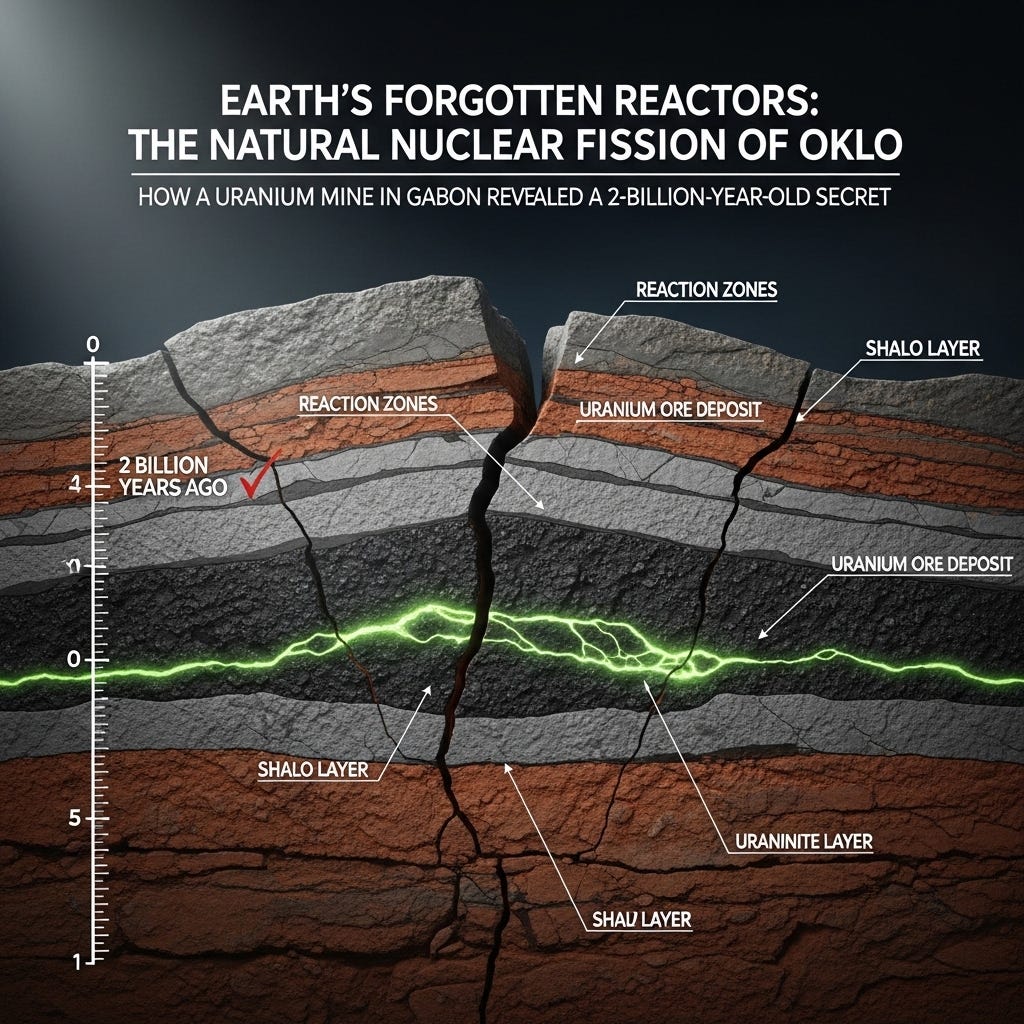
At Oklo, geological processes had concentrated uranium into rich ore veins within ancient river delta sediments, in a basin that was periodically flooded with groundwater. That groundwater turned out to be the missing ingredient: water is an excellent neutron moderator. With high-grade, naturally enriched uranium ore sitting in water-saturated sandstone, the physical conditions for a chain reaction were quietly satisfied, and the rock itself began to fission.
A Self-Regulating Machine, Built by Geology
What makes the Oklo reactors remarkable isn’t just that they existed, but how stable they were. Geochemical evidence indicates that at least 16 separate reactor zones operated within the Oklo, Okelobondo, and nearby Bangombé deposits, intermittently, for a few hundred thousand years.
The reactors appear to have followed a natural feedback cycle:
Water seeped into the uranium-rich rock, moderating neutrons and allowing the fission chain reaction to start.
Fission released heat, which boiled the groundwater away.
Without water to slow the neutrons, the chain reaction stalled.
The rock cooled, water seeped back in, and the cycle began again.
Researchers estimate each cycle lasted on the order of a few hours, with the reactor “on” for perhaps 30 minutes at a time. This crude but effective thermostat kept the reactors from overheating or melting down, and it bears a striking resemblance to the control systems engineers later designed for human-built reactors — except this one assembled itself from sediment, water, and uranium ore, with no operator at all.
Total energy output is estimated at the equivalent of about 100 kilowatts per reactor zone, sustained on and off for several hundred thousand years — modest by the standards of a modern gigawatt-scale power plant, but immense in geological terms.
Reading the Isotopic Fingerprints
The case for natural fission at Oklo doesn’t rest on the missing U-235 alone. Scientists found a constellation of corroborating evidence:
Fission product ratios: Elements like neodymium and ruthenium found in the Oklo ore show isotopic ratios that match the known products of uranium fission rather than the ratios these elements normally have in nature. The “fingerprint” of fission is unmistakable.
Depleted xenon trapped in minerals: Tiny grains of aluminum phosphate minerals in the ore trapped xenon isotopes produced by fission and by the decay of fission products. Because xenon is a noble gas, it doesn’t react chemically — its isotopic composition, sealed in the rock for two billion years, offered scientists an extraordinarily precise way to date the reactors and reconstruct how long they ran.
Plutonium signatures: Some of the original uranium-238 captured neutrons and transmuted into plutonium-239, which itself underwent fission or decayed away over time. Its decay products remain as a chemical signature, even though no plutonium itself survives today.
Together, this evidence allows scientists to reconstruct not just that fission happened, but roughly when it started, how long it lasted, and how much uranium was consumed.
Why Oklo Matters Today
The Oklo reactors are far more than a geological curiosity. They offer scientists two unusual windows that no laboratory experiment can replicate.
A natural laboratory for nuclear waste storage. One of the biggest challenges in managing nuclear waste is predicting whether dangerous isotopes will stay put in a storage site for thousands or millions of years, or migrate into groundwater. Oklo is a real-world experiment that has already run for two billion years. Studies of the site show that many of the fission products and even the plutonium generated by the reactions moved only centimeters from where they were created, despite the presence of groundwater over geological time. This has made Oklo an important reference point for engineers designing deep geological repositories for spent nuclear fuel.
A test of the constancy of physical law. Because the rate of certain nuclear reactions — particularly neutron capture by samarium-149 — depends sensitively on the fine-structure constant (a fundamental number governing the strength of electromagnetic interactions), physicists have used isotopic measurements from Oklo to ask a deep question: have the fundamental constants of physics stayed the same over the past two billion years? The reactor’s “fossilized” nuclear reaction rates provide one of the tightest constraints we have, and the results so far are consistent with these constants being stable over that timescale.
A Humbling Perspective
When the Oklo discovery was announced, it overturned the assumption that controlled nuclear fission was an exclusively human achievement, the product of 20th-century physics and engineering. Instead, the right combination of geology, chemistry, and physics had already run the experiment — quietly, self-regulating, and unobserved — across a span of time so vast it predates multicellular life on Earth.
The Oklo reactors are a reminder that the laws of nuclear physics are written into the universe itself, and that, given the right materials and conditions, nature occasionally discovers them on its own.
Sources for further reading: Reports from the International Atomic Energy Agency (IAEA) on the Oklo phenomenon, and peer-reviewed isotopic studies published in journals such as Earth and Planetary Science Letters and Geochimica et Cosmochimica Acta.
Buy me a coffee www.paypal.me/adrianmcvey