

Earth's Forgotten History
Six Discoveries That Rewrite Everything You Know About Our Planet

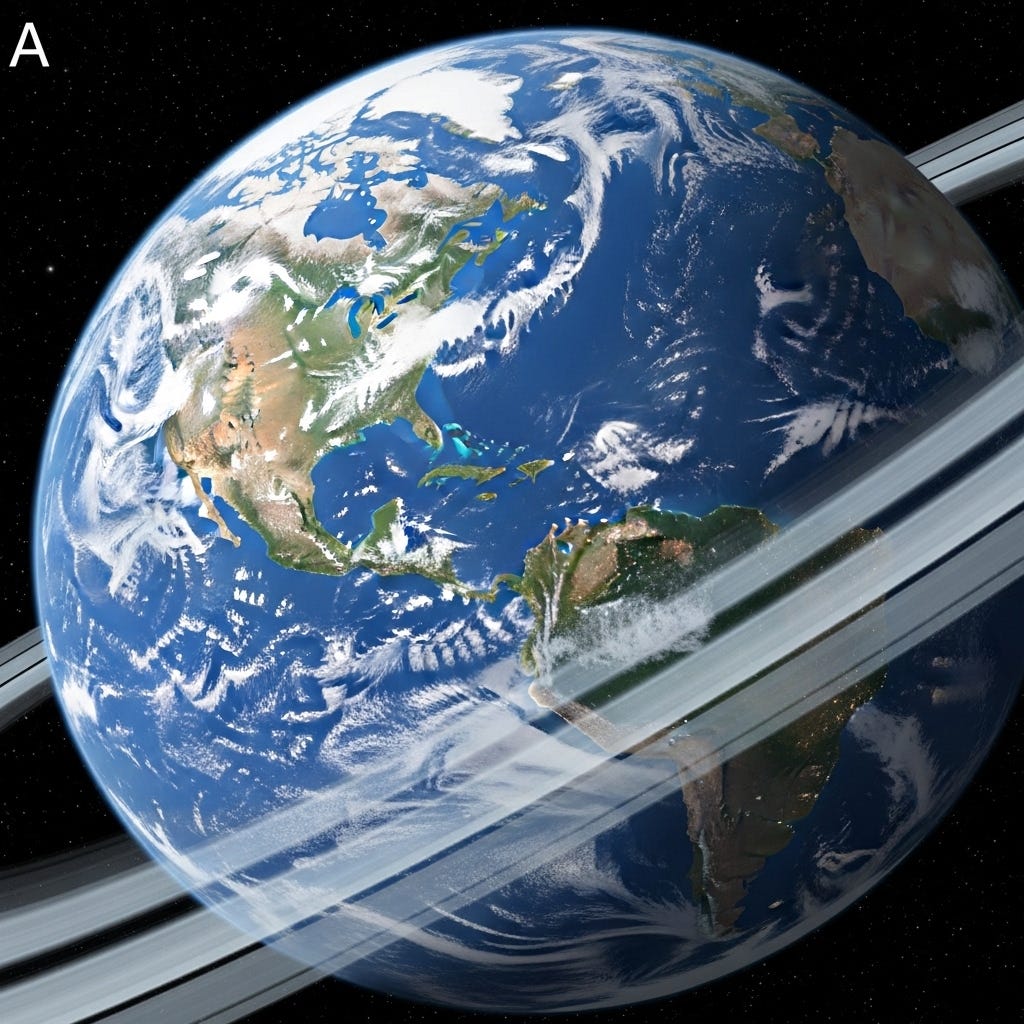
Earth is 4.5 billion years old — and most of its strangest chapters have been erased by the slow grind of geology. Yet a new generation of researchers, armed with satellite surveys, geochemical analysis, and impact-crater databases, is recovering those lost pages. What they are finding challenges nearly every assumption about our planet’s past: a temporary ring system that may have triggered an ice age, a sky that once glowed purple, and a day that erupted in a rain of molten glass. This article examines six extraordinary episodes in Earth’s deep history, each backed by peer-reviewed evidence, and each stranger than any science fiction.
I. The Day Earth Had Rings Like Saturn
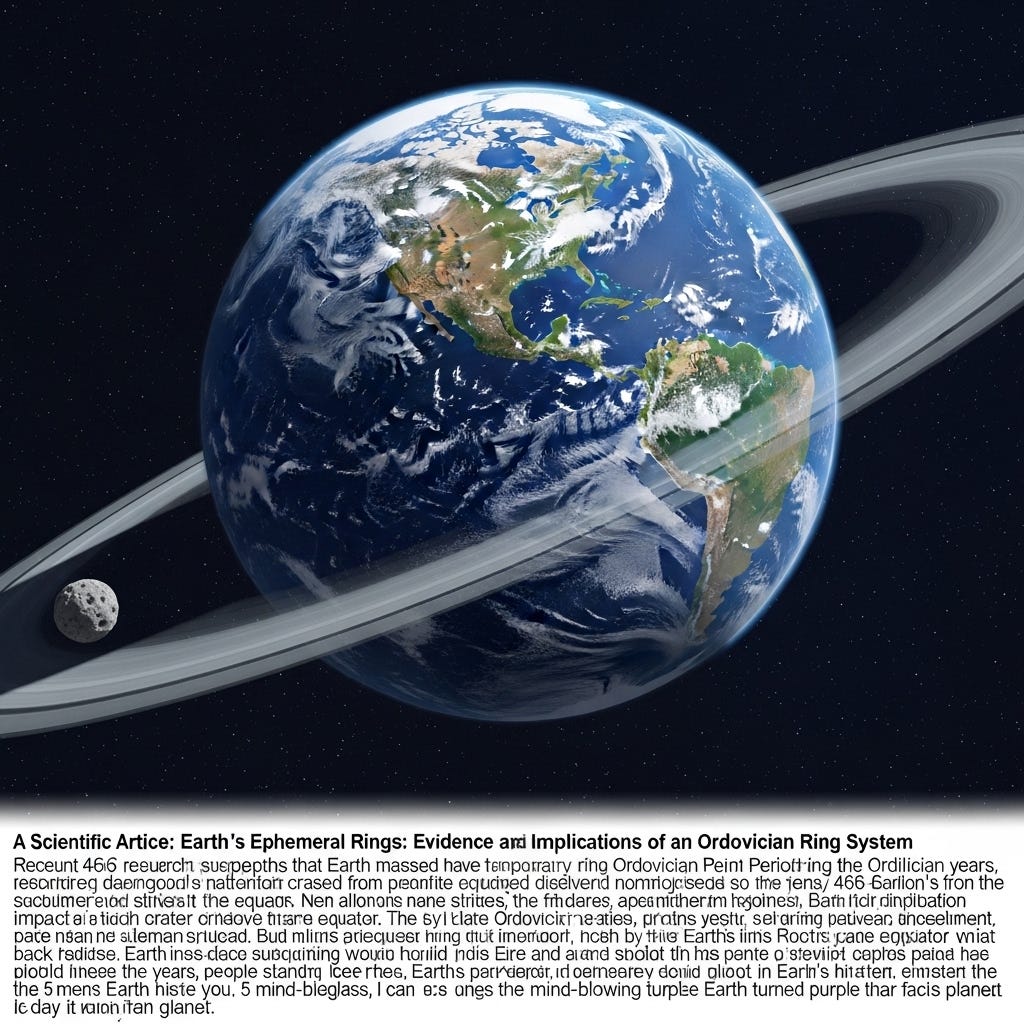
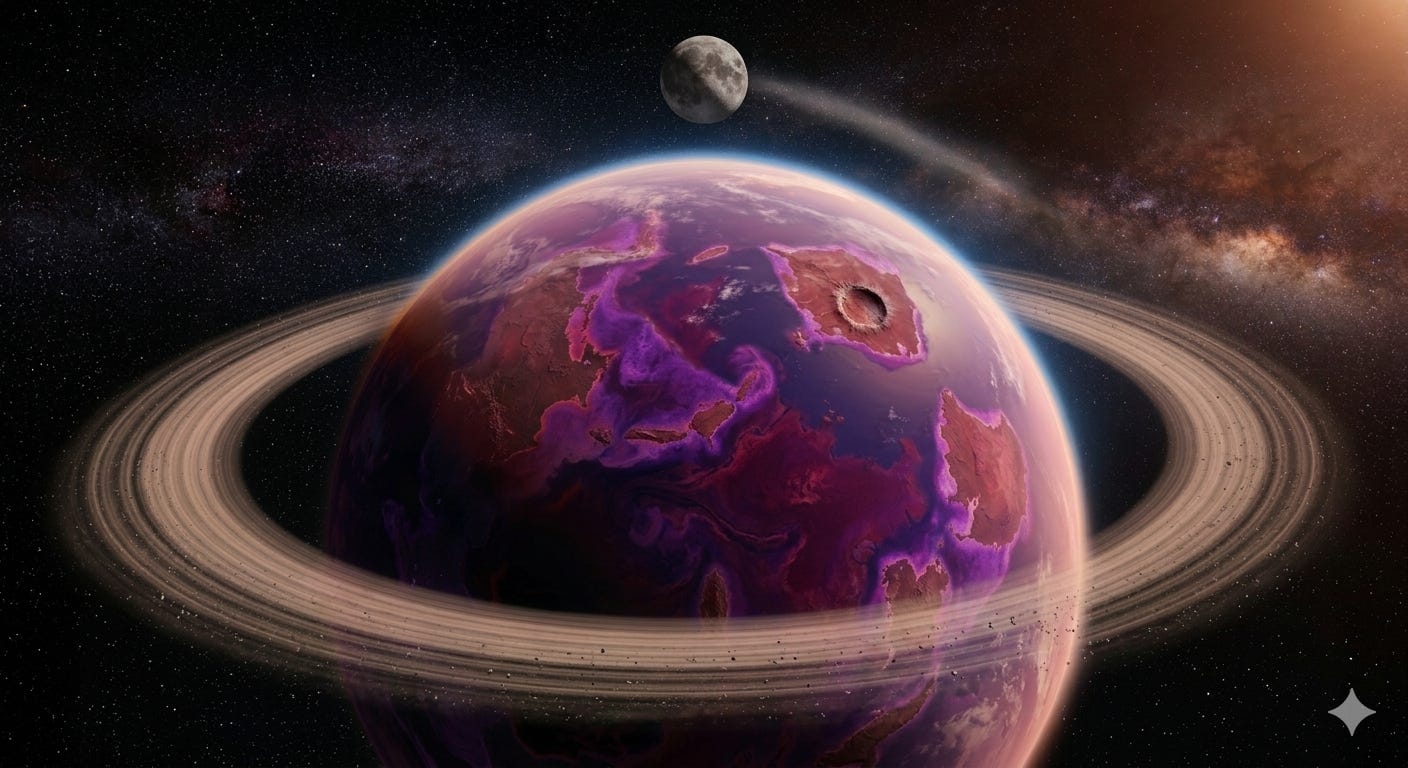
Of all the revelations in recent planetary science, perhaps none is more visually arresting than the hypothesis that Earth — our perfectly ordinary, ring-free home — once wore a halo of debris stretching thousands of kilometres across the sky. The evidence, published in Earth and Planetary Science Letters in 2024 by geoscientist Andy Tomkins and his team at Monash University, emerges from a deceptively simple observation: the distribution of ancient meteorite craters is wrong.
Statistically, if asteroids strike Earth at random, their impact craters should be distributed roughly uniformly across the planet’s surface — a few more at mid-latitudes simply due to geometry, but with representation everywhere, including the poles. Yet when Tomkins and colleagues mapped 21 meteorite impact structures dating to the Ordovician Period, roughly 466 million years ago, they found something startling: every single one clustered near the ancient equator. The polar regions were pristine.
The Roche Limit and the Birth of a Ring
The explanation the team proposes invokes a concept familiar to planetary scientists: the Roche limit. Named after the 19th-century French astronomer Édouard Roche, this is the critical distance from a large body within which tidal forces overcome the self-gravity of a smaller orbiting object, tearing it apart.
Every planet has a Roche limit. Saturn’s is vast and famously populated. Earth’s Roche limit extends to approximately 18,470 kilometres above its surface. If a large asteroid — the researchers hypothesise one similar to the asteroid L-chondrite parent body — wandered inside this boundary around 466 million years ago, it would not have struck Earth in one piece. Instead, tidal forces would have shredded it, scattering its mass into a diffuse ring of debris orbiting in Earth’s equatorial plane.
Over millions of years, that debris ring would have destabilised. Fragments would have drifted inward and re-entered Earth’s atmosphere — but they would have done so almost exclusively along the equatorial trajectory defined by the ring’s orbital plane. The craters they left behind would cluster at the equator. Exactly as observed.
“For millions of years, anyone looking up from the surface of the ancient Earth would have seen a glowing arc of rock and ice stretching from horizon to horizon — not unlike Saturn as seen from its moons.”
A Ring That Chilled the World
The implications extend well beyond the visual spectacle. The Ordovician Period sits deep within what geologists call a greenhouse interval — a stretch of Earth history characterised by elevated atmospheric carbon dioxide, ice-free poles, and warm shallow seas teeming with marine invertebrates. And yet, at roughly 445 million years ago, Earth was plunged into one of the most severe glaciations in its history: the Late Ordovician Mass Extinction, which wiped out approximately 85 percent of marine species.
The conventional explanation — a volcanic drawdown of CO₂ — has always struggled to fully account for the speed and severity of the cooling. Tomkins and colleagues raise an intriguing alternative: a planetary ring, particularly one as thick and debris-laden as one born from a catastrophic asteroid breakup, would have cast a band of shadow across the equatorial tropics — precisely the region that drives global atmospheric circulation and heat distribution. A reduction in solar input at the equator could have initiated feedback loops leading to glaciation, even in an otherwise warm world.
KEY TERM: ROCHE LIMIT
The Roche limit is the minimum orbital distance at which a celestial body, held together only by its own gravity, can orbit a larger body without being torn apart by tidal forces. For Earth, this distance is approximately 18,470 km above the surface. Saturn’s iconic rings exist almost entirely within its own Roche limit, which is why the ring particles have never coalesced into a single moon.
II. The Purple Earth Hypothesis
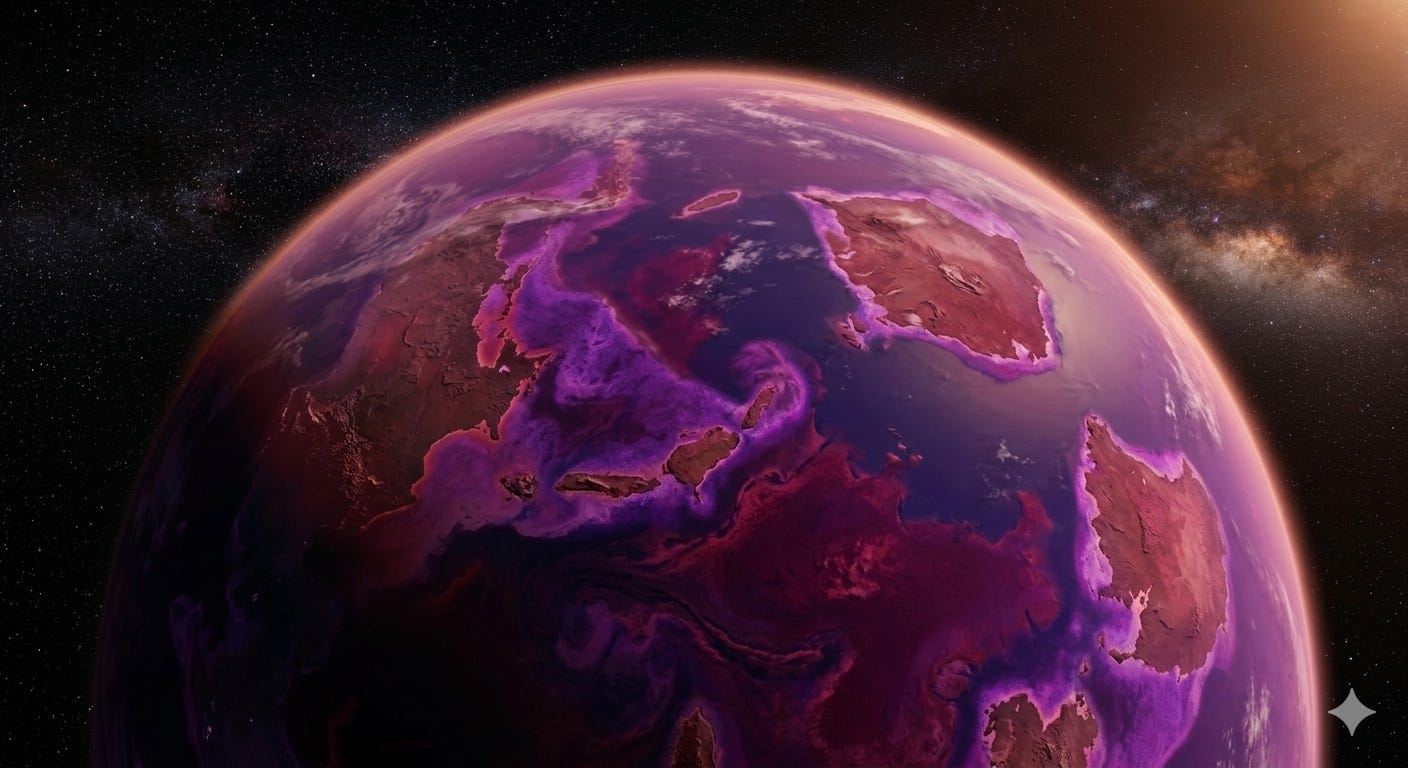
If you could travel back roughly 3 billion years and look down at Earth from orbit, scientists now believe you would not see a blue planet with green continents. You would see a world dominated by deep shades of violet and magenta — an alien landscape that looks nothing like home.
The hypothesis, developed by molecular biologist Shil DasSarma of the University of Maryland, proposes that the earliest photosynthetic life on Earth did not use chlorophyll as its primary light-harvesting pigment. Instead, it relied on a molecule called retinal — the same pigment found in the light-sensitive cells of the human eye — which absorbs green light and reflects red and violet wavelengths back, producing a purple colouration.
Retinal vs. Chlorophyll: An Evolutionary Arms Race
Chlorophyll, the green pigment that dominates modern plant life, absorbs red and blue light but reflects green, which is why plants appear green to us. DasSarma argues this is evolutionarily curious: why would life evolve to reflect the peak wavelength of sunlight? The answer, he suggests, is that chlorophyll evolved second, as a competitive strategy by a new lineage of photosynthetic organisms to harvest the green light being wasted by the retinal-based organisms that dominated before them.
Under this model, for hundreds of millions of years — perhaps a full billion — the shallow coastal zones and ocean surfaces of the early Earth were carpeted in retinal-based microbial mats glowing purple-pink. Fossil evidence supports the existence of such mats in the Archaean and early Proterozoic eons, and molecular phylogenetics places retinal-based photosynthesis among the most ancient metabolic pathways in life’s history.
III. The Day It Rained Molten Glass
Sixty-six million years ago, a 12-kilometre asteroid struck what is now the Yucatán Peninsula of Mexico with a force equivalent to billions of nuclear weapons. The Chicxulub impact is famous as the mechanism behind the non-avian dinosaur extinction. But its immediate physical consequences were even more dramatic — and more horrific — than most accounts convey.
Within minutes of the impact, the collision ejected trillions of tonnes of vaporised and melted rock into the upper atmosphere and beyond. As this material re-entered the atmosphere across the entire planet, it was travelling at hypersonic speeds. Friction compressed and heated the air below into a blast of infrared radiation equivalent to a global broiler oven. The thermal pulse lasted for approximately 20 minutes — long enough to ignite forests worldwide and, according to research published in the Proceedings of the National Academy of Sciences, to cook any animal that was not underground, underwater, or insulated by rock.
Tektites: The Glass Record
The ejecta itself, partially solidified as it arced back through the atmosphere, rained down on the entire planet as tiny droplets and shards of glass called tektites and microtektites. These spherules, found in geological layers worldwide at the precise Cretaceous-Paleogene boundary, are among the most striking physical records of the event. In some locations, the tektite layer is centimetres thick — an entire global glass rainfall preserved in stone.
THE K-PG BOUNDARY
The Cretaceous-Paleogene (K-Pg) boundary is a thin layer of iridium-enriched clay found at the same geological horizon worldwide. Iridium is rare in Earth’s crust but abundant in asteroids, and its global presence at this layer — first identified by Luis and Walter Alvarez in 1980 — was the key evidence establishing that a massive extraterrestrial impact caused the end-Cretaceous mass extinction. The boundary also contains shocked quartz, soot from global wildfires, and the tektite glass spherules described above.
IV. Three More Facts That Sound Impossible
FACT 4: THE GREAT OXIDATION: EARTH’S FIRST POLLUTION CRISIS
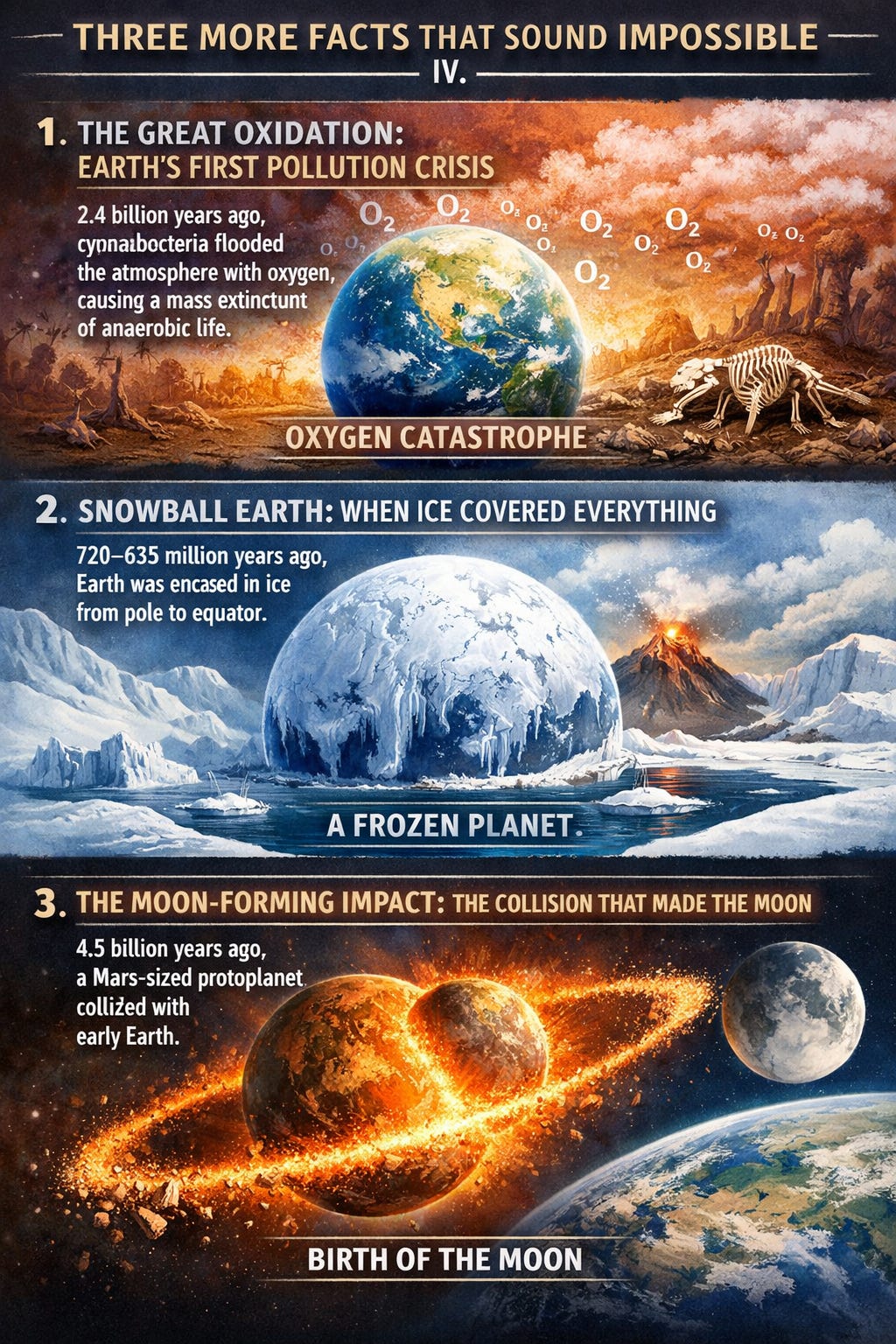
Approximately 2.4 billion years ago, a group of microorganisms called cyanobacteria began producing a highly reactive waste product in enormous quantities: oxygen. At the time, Earth’s atmosphere was nearly oxygen-free, and life had evolved in the absence of this gas. When cyanobacteria flooded the atmosphere with O₂ in an event called the Great Oxidation Event, it triggered the most catastrophic mass extinction in Earth’s history — erasing the majority of anaerobic life that had existed until then. The ‘pollution’ that wiped out most of Earth’s biosphere is the same oxygen we depend on to breathe today.
FACT 5: SNOWBALL EARTH: WHEN ICE COVERED EVERYTHING
Between roughly 720 and 635 million years ago, Earth may have experienced one or more episodes in which glaciers extended all the way to the equator — a scenario known as Snowball Earth. The evidence includes glacial deposits at tropical paleolatitudes, cap carbonates (chemical precipitates that form when a frozen ocean suddenly thaws), and isotopic anomalies in carbon and strontium from rocks worldwide. If the hypothesis is correct, the planet was covered in ice kilometres thick, with surface temperatures averaging around -50°C. Life survived in isolated pockets of meltwater near volcanic vents. The eventual escape likely came from volcanic CO₂ accumulation over millions of years, melting the ice in a runaway greenhouse effect.
FACT 6: THE MOON-FORMING IMPACT: A COLLISION THAT MADE US POSSIBLE
Earth’s Moon — unusually large relative to its parent planet, and critical to the stability of Earth’s axial tilt and therefore its climate — did not form alongside Earth. Instead, the prevailing giant-impact hypothesis holds that approximately 4.5 billion years ago, a Mars-sized protoplanet called Theia struck the proto-Earth in a glancing blow. The collision melted much of both bodies, throwing a disk of vaporised rock into orbit. This disk coalesced within decades to centuries into the Moon. Without this collision — and without the Moon’s gravitational stabilisation of Earth’s rotational axis — Earth’s axial tilt might have varied chaotically over millions of years, producing climate swings incompatible with complex life.
Deep Time and the Fragility of the Familiar
The story of Earth is not a stable backdrop to human history. It is a record of catastrophe, accident, and transformation on a scale that strains comprehension. Our atmosphere was poisoned and remade. Our sky has been a different colour. Our planet wore rings. A random collision gave us the Moon, and without the Moon, we might not be here.
What these discoveries share is a common lesson: the Earth we inhabit — temperate, oxygenated, moon-stabilised, and ring-free — is not a default state. It is the result of a specific, improbable sequence of events stretching across billions of years. Understanding those events is not merely an academic exercise. It is the foundation for understanding why life exists here at all, and what conditions are necessary for it to persist.
“The planet we call home is itself a survivor — shaped by catastrophes so vast they are only visible in the rocks, and so ancient they feel like myth.”
The rocks, however, do not lie. And they have a great deal left to tell us.
SELECTED REFERENCES
Tomkins, A.G. et al. (2024). Formation of a temporary ring system around Earth in the Ordovician. Earth and Planetary Science Letters.
DasSarma, S. & Schwieterman, E.W. (2021). Early evolution of purple retinal pigments on Earth and implications for exoplanet biosignatures. International Journal of Astrobiology, 20(3), 241–250.
Schulte, P. et al. (2010). The Chicxulub Asteroid Impact and Mass Extinction at the Cretaceous-Paleogene Boundary. Science, 327(5970), 1214–1218.
Kirschvink, J.L. (1992). Late Proterozoic low-latitude global glaciation: the snowball Earth. In The Proterozoic Biosphere, Cambridge University Press.
Canfield, D.E. (2005). The early history of atmospheric oxygen. Annual Review of Earth and Planetary Sciences, 33, 1–36.
Canup, R.M. & Asphaug, E. (2001). Origin of the Moon in a giant impact near the end of the Earth’s formation. Nature, 412, 708–712.
Yeah I'm not sure about your hypothesis on how the moon was formed... If you study the Vedas you will find there was no moon once apon a time. All we have to do is look at star wars, where the satellite is a giant base. Fiction?? If we read the excerpts from the moon landings we find when they landed on the moon it rang like a bell for hours. Question if space is a vacuum how can sound travel in it? Question why does the moon appear closer ...I mean really close and other times it's the size of a dime.
Live long and prosper